
Purpose of this document
To record any memory or potential “echo” of my past-life.
Moment of death.
I remember it clearly; it was late 1943, we were on the return path above Holland from a bombing run in Germany — my guns were almost level pointing down a bit and left of the pilot. The Germans below were sending their FLAK as usual… then one of the rounds from the right rear hit too close… The destruction to my body caused severe pain — it was too much so I took my own life by piercing my abdomen with my own knife.
Born in the wrong place.
There was always a lingering sense of that — including the following:
Foreigner.
It always feels like I was not supposed to be born in the Netherlands. Which, in hindsight, is true. The reason for why it happened was caused by the conditions surrounding the death.
Culture shock.
A strong, permanent aversion to the very Ethos of Dutch culture itself.
”I’m stationed here”.
It’s a very typical term for Service Members to use while they are living on-base in a foreign country. When I reflect on the patterns in this life, I could see I have always been in that mode: Going with the flow of the mission, doing what needs to be done, trying to relax in between, living day to day, waiting for the order to go back home. After 32 years, I can safely that order didn’t show up — so I took the path towards creating it myself.
Burnouts.
There were lots of them. Especially when trying to fit in. All the previously mentioned factors contributed to it in many ways.
No romancing.
I was (and still am) not interested in finding a romantic partner while still on the Netherlands. If I ask myself what I would feel if I would ignore that, my body responds with: “You will be tied down here — which makes it a lot harder for you to leave. So don’t. Save it.”
Zero interest in distractions.
Anything that could distract me from “the mission” — even though I was unaware at the time of what that mission was exactly. I just knew it wasn’t what I was doing at the time; “living” without purpose.
The Waiting Game.
Much like life as a Service Members in WWII, the time in between missions (and the missions themselves) had a lot of waiting — just a very different kind. I noticed how I was repeating in this life what I would be doing in between missions: Just enough to be occupied but ready to go at any time.
Childhood behavior (age < 11).
The Drawing
A very detailed and chaotic representation I drew of a war scene during the war in the Pacific. It took me several months with significant time in between to naturally create the drawing and add elements to it.
Drawn elements
At first, a Boeing/Douglas B-17 aircraft (very small) at the top center, pointing to the right, without visual damage. After a while, the second part: a very large battle ship with a large red sun on its hull, pointing to the left. And much later again, I remember wanting to draw a "Yellow Nose" (ME-109), but realizing it would need to have a Swastika on the tail. Scared of it being frowned upon by my peers, I never drew the ME-109 at all. I distinctly remember thinking: “a yellow nose without a Swastika is like drawing Hitler without his mustache”.
The Book
I looked multiple times through a large, thick, ~400-page book consisting of mainly photographs which was translated from English (title: “World War II: 50th Anniversary Commemorative Edition”) to Dutch (title: “Gedenkboek van de Tweede Wereldoorlog”) by Ivor Matanle. I remember a very deep, serious non-glorifying sensation while looking at it’s contents as if I was looking for a long lost friend. As well as empathy, sorrow, and respect towards the many young Germans depicted in the book.
Pant belts
I systematically over-tightened it to extremes. Letting it looser would cause spiraling anxiety — I hid doing so from others.
Body posturing
I would lay in my tall bed — which was close to the ceiling of my small room, extend my elbows out sideways so I could feel the pressure against the side railings, raise my feet all the way up to touch the ceiling, and hold that position for as long as I could — it created the sense of being stable… even though it did not. I had no idea why I was doing it — until I started doing the research.
Childhood behavior (age > 11)
American English
I taught myself to become fluent in it -- before it was taught in school.
“Dog tags”:
I ordered a pair from the United States because I wanted to — I still have those. Each tag had room for five rows. I remember how the first four lines came easily — except the last one. I blanked out. But that somehow allowed me to go deeper and extract information I was not consciously aware of.
What are "dog tags"?
They are a set of U.S. Army-issued small identical rectangular shaped “plates” worn on a necklace with information about the soldier/airman on them. It usually included things like name, date of birth, religion, sometimes service number and so on.
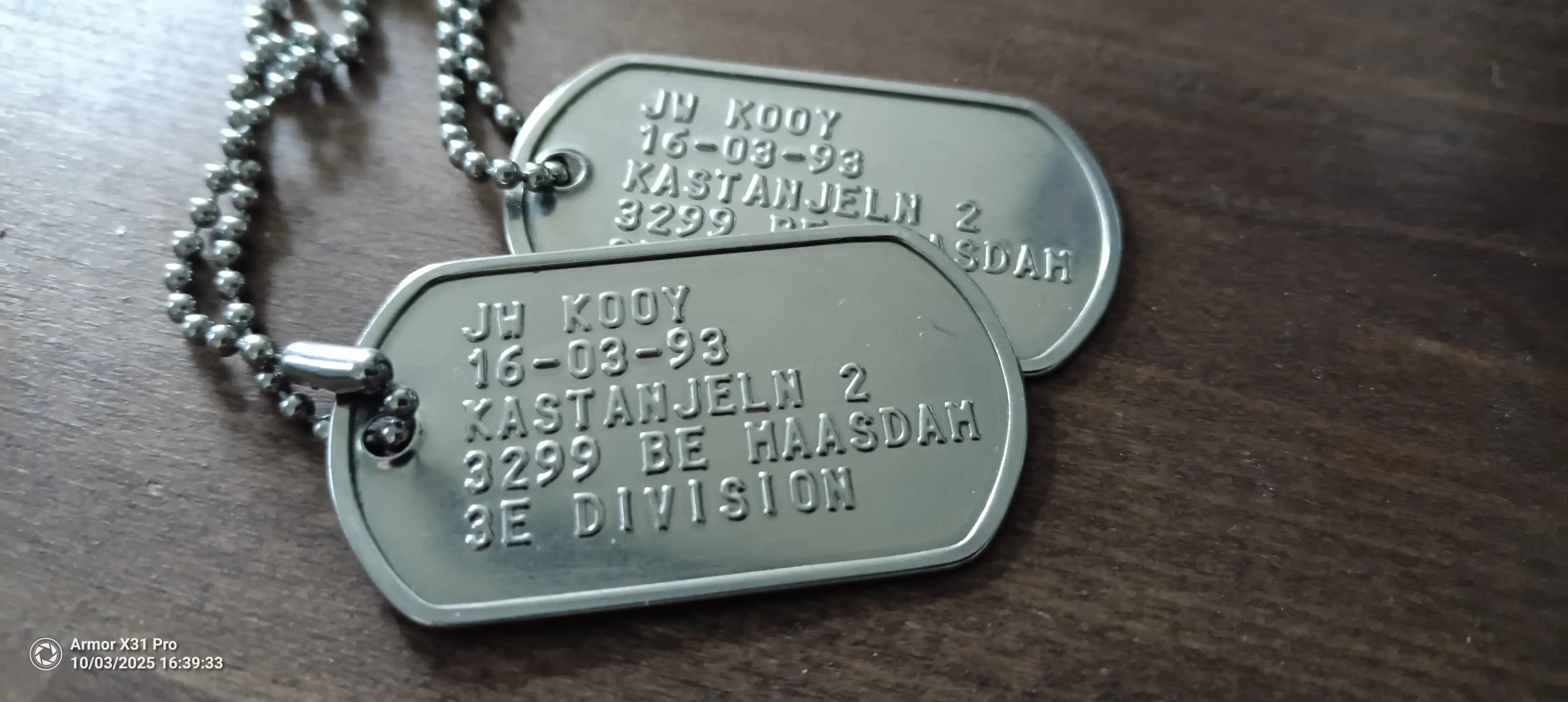
Multiple years later I felt like ordering another set which had different lines and not made in the U.S.A. I ordered a total of three sets. Each set carried it’s own meaning displayed through what was on them.
Symbology behind birth names.
At birth, I was given two names: Willem and Nelis. Somehow, I never felt anything for the first name. But I absolutely did feel something with the name Nelis. You might know about the military base named “Nellis Air Force Base”. Well, I certainly remembered that base based on its name alone, so while doing my research, I looked it up to see why it is named that way. When I found out, I almost fell off my chair because who the base was named after, and what his name was: William Harrell Nellis.
It is the name of the WWII Bomber Escort Pilot who’s job it was to protect bomber formations. Including mine. I distinctly remember being escorted by multiple P-51 Mustang fighter aircraft over The Channel, up until roughly the Dutch coast, which is where they peeled off to RTB. I remember the fear coming in afterwards — as well as the relief from reaching The Channel on our return leg, because that meant they were joining us until we were in safe airspace. Back then, they lacked the range to go further — which I something I found only after doing the research. That is one great example of how I remember historically verifiable facts before knowing about them from research.
“Mission Safe”.
While trying to debunk my own past-life memories, I came across those two words purely by accident. And I got a very strong and unusual calming sensation from reading that. So I became very curious why it had such a strong effect on my body even though I could not immediately recall what it referred to — it was used by B-17 bomber crew once the formation reached friendly airspace after a mission. I now use it when my nervous system is stressed out — which unfortunately is often due to how unhealthy my current environment is for me.
Compulsory clothing habits
Important note
The compulsory aspect is physical as well as visual. Which means I can feel distress/comfort simply by feeling AND seeing — even in other people. None of them are because of external influence. Instead, I have been mocked/questioned/criticized/bullied over it.
Wrists and ankles
I need to feel pressure there, but the need is greatly reduced when no fabric is touching the area around the wrists. I still prefer having pressure there though — I have found sweatbands to be the perfect solution. And it looks good too in my opinion 🙂
Boots.
It’s the only type of footwear I can tolerate. There is something deeply worrying me if I wear anything less tall than above-the-ankle footwear.
Pants.
They must have ==tapered ends and leg pockets==. Many “cargo pants” have that style. I’m totally okay with it being somewhat loose anywhere between the ends and waist. Even though many pants have slash pockets, I barely use them unless I have to. There’s just something that doesn’t feel right about using them somehow — I automatically put things in my thigh pockets…
Historical Context
This one is fascinating to me because this exactly mirrors the flight suit, typical behavior and needs of a ball turret gunner during missions — the outer pants did not have slash pockets at all simply because there was no way to get anything out of it even if they were there. However, the thigh pockets were still available and functioning as the primary storage place. The tapered ends were there to keep the cold out. Which was severe at high altitudes. Frostbite was unfortunately a common occurrence.
Layering of clothing.
It drives me CRAZY when my thermal shirt (touching skin) is tucked into the thermal pants — here’s why: it creates a gap between the skin and fabric due to “waves” which means the pants don’t seal properly around the waist since it leaves an air gap. To most people, that might sound like something trivial. But to me, it literally feels like the difference between life and death at the consciousness level, not the logical. I cannot focus on anything else until I correct the layers.
Then, any additional layers on top have to go like this: pants over the thermal shirt, and then additional layers on the torso will go over the pants. The overall theme here is that the base layers (including the outer pants) need to create a tight seal.
Historical context
Here’s where it gets really interesting… my way of doing that was not standardized practice defined in the U.S. Army Air Force handbook. Rather, it said the thermal shirt needed to be tucked in. But in reality, the B-17 crew members (especially the ball turret gunner) knew better… which was exactly what I described above; if that first layer had ANY leak, gap, or wrinkle in it at the waist, it would create an infinite amount of misery during the whole mission because of all the motion, and the serious threat of Frostbite.
Suits and formal clothing.
I HATE them because I feel stiff, uncomfortable, bureaucratic, “official”, “office man”, restricted, a dressed clown, all while wearing something that isn’t practical in any way shape or form — it’s just for show… I especially resent the feeling of those loose suit pants that are constantly moving around and not fitted to my legs. I can recall that exact feeling at this very moment and I feel a lot of negative emotions when I do.
Historical Context
Another very telling historically verifiable fact here; there are many veteran’s accounts who say exactly the same thing I just said, maybe with other words, but it all comes down to the same. They preferred their actual survival gear, not the “clown suit”. That is how I still see it to this day.
Neck warmers.
Finally, something on this list I actually like 😆 I wear them as soon as the surrounding air creates any kind of discomfort there. The protective feeling of it calms my nervous system.
Historical Context
Again, this is another great example of how my current-day habits perfectly reflect what was not just normal for a ball turret gunner, but crucial for survival in a high-stakes environment. There are also veteran accounts that mention how they still like the calming effect of wearing something around the neck.
All those habits mentioned above are far from superficial — they feel programmed into my nervous system. Any attempt to deviate from that programming is like writing my own psychological death sentence — or at best; create a bunch more useless stress on my body.
Somatic memories and potential symptoms
**DISCLAIMER**: The following symptoms could have causes unrelated to my past life. I am simply mentioning them here in case it is later found to be relevant.
Peeing into a condom.
Yes, you read that right 😆 I once had a moment where I felt the “need” (for lack of a better word) to pee into a condom. It felt strangely familiar and relieving — but not in a sexual or fetish kind of way. The act was far from necessary; I was just steps away from a fully functioning in-house toilet. Much later, while watching interviews with fellow B-17 airmen, I learned the only way to relieve oneself on board was to pee into a condom. That realization shook me. It was one of those puzzle pieces — quiet, absurd, and dead-on — that suddenly made sense.
Loss of balance in the dark.
As soon as I cannot see the horizon or at least some resemblance of orientation due to lack of light, my senses for orientation feel as if they shut off entirely. The only way for me to balance myself under those conditions is to focus on pressure on the bottom of my feet.
Historical Context
This can also be verified with veteran’s accounts. Not directly, but inferred from the physical symptoms they had during and after night time missions — combined with known facts about how the body can adapt do extreme situations to prevent the severe nausea and vomiting that would happen without adaption. Imagine vomiting inside a ball turret at -40C and no oxygen unless you put your mask back on.
Upper-body shakes.
Involuntary, ~2 second horizontal rotational shoulder back-and-forth motion while relieving myself and holding specific posture — paired with involuntary sound from my mouth while the jaw is all the way down. It is common and has been so as far back as I can remember.
Context
This could be analyzed by an expert of somatic echoes — it could be a way for my body to release stuck trauma. I don’t know enough about it to make any affirmative statements. I included here for experts to see it.
Back posture Proprioception
I can see a big difference in how the curvature of my back looks compared to how it feels. That could be interpreted as another somatic echo because of how the spine of the ball turret gunner was curved during the entire duration of each mission.
A pulse in unusual spots
Depending on my emotional state, I can feel a pulse close to the spot I remember piercing to end my previous life.
Involuntary Motor Memory: The Tucked-Thumb Salute
While researching to debunk my own memories against historical records, I studied how the standard U.S. military salute was performed. Knowing that past-life memories can sometimes resurface through specific physical movements, I decided to run a test. I stood up straight, heels together, closed my eyes, and “triggered” myself to salute — just to see what would happen.
That’s when I noticed something odd: my body automatically defaulted to a very specific — and obviously non-standard — form. Instead of keeping the thumb aligned with the fingers, I instinctively tucked it under my palm, so the tip rested near the base of the pinky.
I have no memory of ever being taught this variation in my current life. It makes no sense for me to do this unless it’s coming from somewhere else — especially considering that every available historical source insists the U.S. Army used a consistent standard across all units, with no documented deviations.
Maybe one day, if I gain access to non-digitized records or oral histories, I’ll find proof of informal variations. Until then, this remains one more unexplained detail — but one that feels important enough to document.
Feet
As a teenager living in a socially toxic environment, I had severely curled/arced toes. It took a lot of regular walking and complete removal from that environment to reverse it. The process took many months and was very painful. It slowly got better over time to a point where I could easily walk for anywhere between one hour and two hours without pain in my feet.
Visiting airshows and Military Cemeteries
While I was a young boy, my peers took me to a Military Airshow and later to a Military Cemetery in the Ardennes. I remember it as if it were yesterday. I felt a deep connection and sorrow for all the lives lost. I saw old veterans there, dressed in uniform. I wanted to reach out and pay my respects but I was aware of my young body and how it might be perceived. Out of fear of being misunderstood, I did not act on my intention. Maybe I should have just walked up to the man and shaken his hand. It might have confused him for the rest of his life — but it would have been directly from the heart.
Confined spaces
Moving around in tight spaces can enrage me very quickly. Even slightly bumping into things triggers a visceral response. It reminds me of how difficult it was to get in and out of the ball turret without hurting my body.
Wind gusts
They get on my nerves very quickly — to the point where it sends me into a spiraling rage. It reminds me of the sudden air burst from FLAK.
Holding bulky knives
It will trigger sudden flashbacks of stabbing myself in a very particular spot of the abdomen; roughly one inch below the belly button towards my right hand, as seen from my perspective. It includes a strange energetic sensation coming from that area.
Important psychological context
I don’t have a history of hurting my own body on purpose or wanting to. The first time I experienced the flashback, I recoiled and I clearly felt I did not want to do what the flashback was showing — and neither did the flashback itself show it as something I should do. After it happened a couple times, I started to wonder why and eventually once I became more open to my past-life memories, I had the courage to ask myself what the reason was for the flashbacks. The answer came immediately, and it was what I start this document with.
In addition to those flashbacks, there are times when I can feel a sudden and very distinct jolt of pain in that exact spot. It tends to happen only when my upper body is in a position that resembles the kind I had while inside the ball turret.
Past-life Family
One of my self-initiated Intentional regression sessions revealed the name of a much younger sister: Mary. I was not able to go deeper than that because I felt a energetic resistance towards digging up that part of my past. It’s safe to say I am deeply aware of the consequences of me leaving my family behind to fight in another man’s war.
Crew members
The name “Billy” (Pilot) came up during another one of my intentional regression sessions through imagining being back in the ball turret once more. I know the name is common, but it may later prove to be a vital piece in the puzzle.
Response to specific expressions
Catching FLAK
Before I knew why, that saying would trigger something inside of me that didn’t feel like it came from anything I have experienced in this life. I felt a visceral response to it but I suppressed it because I was also aware of how the response seemed not entirely about the situation in which the term was used.
Use of language
I can smoothly switch between English and Dutch. and Vice Versa. I can think very clearly in English. Better than Dutch. I only speak Dutch when I need to or sometimes when talking about a specific situation related to my current life — which most of the time I even do in English. Even after 32 years, my sentence structure isn’t fully native. Native speakers will understand, but they might notice the difference in flow — because it resembles direct translation from American English.
Inherent need for clarity and structure
What civilians will see as OCD or Control-freaky behavior, I see as focus and clarity. The removal of vagueness. A clear objective. Structure. No chaos. Once I have that, I can relax. While civilians look at me like I’m some freak who goes nuts without “controlling everything”. That, is why I will never fit in with civilians who don’t know what it’s like to live in a high-stakes environment. They just don’t get it.
Context
I never knew that way of thinking is a very common state echoed by combat veterans from any war. Unfortunately, they are often labeled for it and treated as something that should be “fixed”. I advocate for not trying to suppress it, but instead, cultivate a healthy relationship and awareness towards why it is that way, and to just let it be without trying to control it. I have experienced great benefit from looking at it in that way, because the anxiety levels surrounding it are greatly reduced. In practice, it means: I can live the way I am without being panicky or manic about it.
No ego, just teamwork
I have no interest in one-upmanship, ego battles, or the need to be better than someone else. My priority has always been the team, the mission, and getting things done without the distractions of competition. It’s not about who is better — it’s about everyone making it through by combining all strengths. That’s why I can’t stand ego-driven games civilians often play. In my world, it’s all about teamwork and shared purpose, not trying to outshine anyone else.
Context
This mindset perfectly resembles the kind of mindset one needs in battle. Fighting your team as well as the enemy is a bad idea.
Behavioral patterns
DISCLAIMER: the patterns listed below could be directly linked to my past-life or be influenced by my current life. Either way, they do still match up perfectly.
The red thread
Sticking to low-commitment things, so I could easily drop them in favor of a sudden “higher objective”.
Romance
Despite a desire for meaningful intimacy, I avoid getting romantically (and physically) involved with women. Part of it is because I don’t want to be tied down to the Netherlands, but the same was the case for wartime England; starting a relationship with a woman there came with many complications.
The “ready-bag”
I always have some bag somewhere with essential things in it. I have never needed it yet, but it’s just one of those things I naturally do without knowing precisely why — unless I look at it from the perspective of my past-life memories. It signals the body: “I’m ready to go at any time because I already have my essentials packed”.
Speech patterns
My jaw movement is minimal by default. When I asked my Soul why, the answer was: "oxygen mask".
Context
Significant movement of the jaw or mouth would create a gap between the face and oxygen mask which means loss of a vital finite resource. Therefore it was crucial to adapt speech.
Auditory memory
B-17 engine sound
I remember wanting to listen to a perfect high quality steady loop-able recording of B-17 engines to calm my nerves. Unfortunately, those are impossible to find. So pink noise will have to do for now.
Physical body aspects
DISCLAIMER: I am providing the information below without assuming anything about how it relates to my past life. It is simply here to serve as a record for potential future research.
Context
None of my family members have a build like my body. I am by far the skinniest of everyone. At this very moment I’m on my path to replenishing a chronic Magnesium deficiency, which absolutely has an impact on muscle mass — based on it’s role in the body.
Body build
Nicely defined, but obviously lacking in volume. Wide shoulders, great muscle definition, but a serious lack of muscle mass — all at 6 Feet tall.
Skull
Flat at the back. very pronounced “knob” in the center at ear level.
Torso
It’s short compared to the rest. Very defined and widens towards the shoulders.
Back
Half-inch birthmarks at the height of the thoracic spine.
Spine
A slight bend to the left (rear view) in the Thoracic Spine. Which is the most likely cause of the asymmetrical waist line.
Spine (range of curvature)
Extreme. Possible to move my Thoracic Spine into a small ball-like bend.
Abdomen
Scattered smaller birthmarks on the front, between the belly button and sternum.
Wrists
Narrow and slender.
Legs
Small but very visible red dots. Initially thought to be Keratosis Pilaris but it stayed even after significantly lowering inflammation through diet and doing all the typical skin cleanses. details about positioning: top legs has the worst bits on the front. sides less bad, the back has almost nothing. lower legs: more uniform, all around. feet: only the top center where the hair is.
Context
Since I have had those red dots since I can remember, I started to wonder if it could somehow be a remnant of my past-life physical trauma. There is however a potential other mechanism causing it which is my chronic Magnesium deficiency I’m now in the process of resolving. Once I fix that, if the red dots still remain, it becomes more likely that it is indeed a past-life trauma echo.
Feet
Almost flat top surface. Hard to find a good fit for boots because most have steep top arcs which makes it impossible for me to get a snug fit.
Body posture in teenage years
Very hunched. It has improved with exercise, diet and time. But the tendency of my back to arc forward remains a theme.
Vehicle affinities & aversions
The Willys Jeep
Honestly, I hate that thing. And that is a mild way of expressing my frustration with it. I hate the obnoxious high pitched fan-like sound of the engine. And comfort was bad too. Ironically: my mother’s name is Willy and I never had a good relationship with her — to say the least.
Bigger vehicles
I have always liked and preferred taller and utilitarian trucks. Bonus points for anything I need to climb into.
Gear choices for riding my motorcycle
Pants
As usual, must be tapered at the bottom, or at least narrow enough to create a decent seal. I get a visceral reaction to loose ends.
Impact vest
A plate carrier vest I modified to fit heavy 3/4” thick insulation material instead of actual ballistic plates. I naturally came to that decision without too much thought; it was and is totally normal to me. The idea is to protect the vitals against foreign objects.
Context
A B-17 ball turret gunner in late 1943 wore a M1 FLAK Vest.
Gadgets and tools
Wristwatch
For a while I wore it like everybody else because I wasn’t in tune with what my body was asking for. As soon as I listened to what I would do instead of how others do it, I flipped it so the face points down — without giving it a second thought.
Context
I had it like that for multiple years before I went heavy into the research of my own memories — which lead me to the discovery of yet another historically verifiable trait: many (if not all) airmen serving as ball turret gunner wore their watch with the face on the side of the palm — entirely for many practical reasons. Due to the posture inside the turret, it would be very difficult to read the watch if it was on the “normal” side — due to the well-known “elbow swing” effect. Having it on the opposite side would allow for a quick peak with very little movement needed.
Knife
Even though I don’t have an immediate reason to wear one, I still do because it feels totally natural to me like it’s part of my body. And again, without thinking about it, I wore it on the right side hip, the blade pointing up while the sharp end points rearward.
Context
This exact way of wearing it was the most efficient way for a ball turret gunner due to the limited space. It allowed for a quick motion from draw to use.
Jackets
Pockets
I like pockets. Even when not in use. It’s standard procedure for me and I don’t even think twice about it.
Velcro
All my jackets have a place to put arm patches. I design patches myself and wear them because of what they mean to me.
Language dissonance
The Dutch, harsh G sound
It is intolerable to me. Impossible to bear it or “block it out”. I mute it when I speak.
English with a Dutch accent
I have a very low tolerance for it. I’m not sure why, but it drives me crazy. I naturally got rid of it without even trying.
Emotional Attitude
NOTE: none of the traits below originate from the current lifetime. Rather, they were all *actively dismissed and labeled as "rebellious"*
”Authority”
An instinctive “prove it” mentality. I’ve had my fill of those young inexperienced Officers who just show up thinking they can tell me and my crew what to do without knowing what real combat is like. You don’t know shit, son!
Power hungry Drill Sergeants
It’s the ultimate narcissism magnet. Plenty of daily opportunities to make others feel like they are below you.
Military service
I have a strong aversion to it. That’s what dying in someone else’s war will get you.
Patriotism
There is a crucial difference between true Patriotism and blindly following orders labeled as such.
”War heroes”
There are no heroes in war. Just men, doing what they do for many different reasons. None of them are heroic.
Pride of Service
I am not proud of killing many young German airmen as well as contributing to the slaughter of many innocent women and children during our inaccurate bombing runs on civilian targets.
Rank or Status
I recall young fresh-out-of-camp Officers showing up to my unit, thinking they own the damn place. The guy has never seen the shitty side of war. And thinks he can lead men into it. Well, he had to prove his worth. Which leaves me with another Echo from the Past: I never assume a stranger is worthy of the Rank or Status they claim.
Music
This deserves its own section because something unusual happens when I hear music from the 1940s: I light up. I get emotional. I start to swing like I have heard the song a thousand times. I have listened to a wide range of music over the years, and nothing hits me like this does — not even close.
Here is the kicker: the idea to create this very section came while listening to a modern band playing 1940s-style music. I was half-focused, swinging hard, when I went to type “Music” as the title — but instead, I typed: “Mission”.
Things that remind me of “the good old days”
- Dense Pine/Spruce forests: mixed with natural open lush spaces, shallow streams, and Snow-top mountain ranges the distance.
- 1940s music: that sound and style triggered a lot of emotions when listening to it after realizing that my story is something much more than “just a delusion”.
- Pin-up girls: the symbol of real beauty on the outside as well as on the inside. Innocence. Real feminine features. Classy. Stylish. Alure. Confidence. Loving. Daring. Emotional attractiveness as well as physical. It was a symbol of something deeper than just the appearance.